 By
By 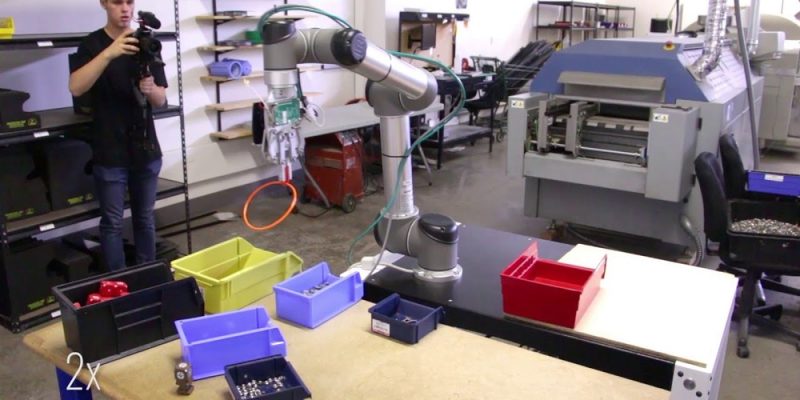
For decades, factory automation was a game played exclusively by industrial giants. Massive capital expenditures, permanent floor reconfigurations, and dedicated software teams were the baseline requirements for introducing robotics. Smaller and medium-sized facilities looked on from the sidelines, reliant on manual labor and flexible but slower production setups. That dividing line is disappearing.
A shift toward accessible, modular technology has changed the economics of the factory floor. Smaller operations do not need to automate an entire facility to see a return; instead, they are finding success by targeting specific bottlenecks.
The Myth of Total Automation
When small business owners consider automation, they often picture fully autonomous, dark warehouses. This misconception often leads to strategic paralysis. For a business managing high-mix, low-volume production runs, total automation is actually a liability. It introduces rigidity where agility is required.
Practical automation focuses on incremental changes. If a technician spends four hours a day loading raw metal stock into a CNC machine, that specific task is a candidate for mechanical assistance. Automating that single interaction frees up half a shift of human problem-solving. The goal is to elevate the workforce, not replace it.
Smaller enterprises succeed by focusing on setups that can be adapted within hours. When a product line changes, the machinery must change with it, requiring minimal technical friction.
Strategic Deployment and Task Selection
Identifying where to insert machinery requires a clear view of daily floor metrics. High-turnover positions, repetitive tasks prone to human error, and ergonomically hazardous roles yield the highest return on investment.
Consider the packaging department. Workers stacking boxes onto pallets for hours face physical strain, leading to fatigue and variable output near the end of a shift. A dedicated mechanical arm can manage the heavy lifting consistently, maintaining an identical pace from morning to night.
By isolating these predictable steps, managers protect their teams from repetitive injuries while stabilizing daily throughput. The human workers shift to quality control, machine setup, and process optimization-roles where human judgment is irreplaceable.
Overcoming Space and Programming Constraints
Traditional automation requires a lot of space. Safety cages isolate fast-moving, heavy arms from human traffic, creating a massive physical footprint. Smaller facilities rarely have spare square footage to give up.
This spatial constraint has driven the adoption of safer, more perceptive machinery. Modern systems rely on internal torque sensors and proximity detection to operate safely in close quarters. A business can position a collaborative robot directly next to an existing assembly line without erecting physical fences. If a human worker brushes against the machinery, it pauses instantly, eliminating the need for massive safety zones.
Beyond floor space, the software barrier has also dropped. Early industrial units required specialized programming languages. Modern lightweight systems use visual, block-based interfaces on standard tablets.
Training a machine to pick up a part no longer requires writing code. A floor supervisor can physically guide the arm through the correct motions, saving waypoints with the press of a button. This approach shifts ownership of the technology from outside consultants to the existing floor staff.
Financial Realities and Variable Lifespans
The financial analysis of purchasing machinery has changed for mid-sized manufacturers. Historically, an industrial robot was a fixed asset, dedicated to one specific product line for its entire decade-long lifespan. If that product line died, the investment was lost.
Modern modular tools change that calculation. The mechanical arm is simply a baseline mover; the true utility comes from interchangeable end effectors, like grippers, sanders, and vision sensors. If a factory stops producing a specific component, the arm can be unbolted from the bench, fitted with a vacuum gripper, and wheeled to the shipping bay to pack boxes.
This flexibility changes how capital expenditure is assessed. The equipment becomes a fluid asset that can adapt to changing contracts and seasonal demand, significantly lowering the long-term risk of adoption.
Balancing Human Capital with Digital Tools
The introduction of automation often sparks concerns about workforce displacement. In practice, smaller factories using targeted machinery often expand their headcount over time. By reducing production costs and lowering scrap rates, these businesses become more competitive, winning larger contracts that require scaling up overall operations.
The workforce undergoes a shift in skills. A worker who previously spent the day manually moving parts becomes a machine operator, managing the scheduling and maintenance of the digital tools. This transition increases engagement and reduces the turnover rates that typically plague repetitive manufacturing roles.
Success does not come from buying the most expensive system on the market. It comes from understanding the exact point where human hands lose efficiency and digital precision takes over. Smaller enterprises that respect this balance can scale their output without losing the adaptability that made them successful in the first place.










Comments